
How Much Does a Small Business Website Cost in the UK? (2026 Guide)
Thought about a website for your business?
If you've started researching a new website for your business, you've probably noticed the answer to "how much does a website cost?" ranges wildly — anywhere from £300 to £30,000. That's not a typo, and it's not sales agencies being cagey. The cost genuinely depends on what you're building and why.
This guide breaks down real UK pricing ranges for 2026, what actually drives the cost up or down, and how to figure out what your business needs — not what a template site is trying to upsell you.
Why website pricing varies so much
A website isn't one product. A single-page site for a sole trader and a booking-enabled portal for a multi-location clinic are both "websites," but they solve completely different problems. Price follows complexity, not page count alone.
The main cost drivers are:
- Custom design vs. template — A DIY builder (Wix, Squarespace) or a templated WordPress theme costs far less upfront but limits what the site can do and how it looks compared to a bespoke build.
- Functionality — A brochure site (services, contact form, about page) is the cheapest tier. Add booking systems, payment processing, client portals, or inventory integration, and cost climbs accordingly.
- Content — Professional copywriting, photography, and SEO-optimised pages take time, and that time is billed.
- Ongoing needs — Hosting, maintenance, security updates, and support are often quoted separately from the build itself.
Typical UK price ranges in 2026
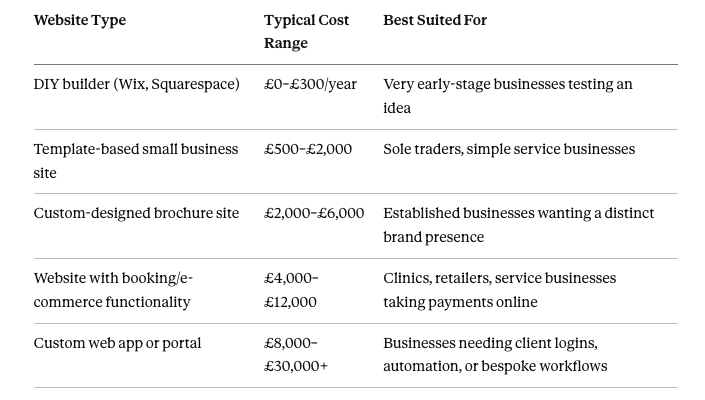
These are indicative ranges, not fixed quotes — the right way to get an accurate number is a conversation about what the site actually needs to do.
What's usually NOT included in the headline price
This is where a lot of business owners get caught out later:
- Hosting and domain renewal — usually £50–£300/year, billed separately.
- Ongoing maintenance — software updates, security patches, backups. Skipping this is how sites get hacked or break silently.
- Content updates after launch — some agencies charge per change; others include a set number of hours.
- Third-party integrations — booking systems, payment gateways, and CRM connections sometimes carry their own subscription fees on top of the build cost.
Ask any web developer upfront what's included in the quote and what happens after month one — a cheap build with expensive ongoing costs can end up pricier over three years than a well-scoped custom build.
Cheap vs. custom: what you actually get for the difference
A £500 template site and a £5,000 custom site aren't the same product at different prices — they're different products.
- Template sites are fast to launch and fine for validating an idea, but they're limited in design flexibility, often slower to load, and harder to scale if your business grows past their built-in features.
- Custom-built sites are designed around your specific business processes — so if you need a booking flow that matches how your clinic actually schedules appointments, or an inventory system that reflects how your warehouse tracks stock, a custom build can actually save time and manual admin, not just look better.
The right choice depends on stage of business, not just budget. A new sole trader testing demand doesn't need a £10,000 build. A growing clinic juggling manual booking calls almost certainly loses more in missed appointments than a proper booking system would cost.
How to budget for your website
A useful way to think about it: budget for the site that matches your business today, but ask your developer whether it can grow with you. A well-built custom site is usually structured so that automation or e-commerce functionality can be added later without a full rebuild — which is often cheaper in the long run than repeatedly outgrowing template limitations.
Getting an accurate quote
Because so much depends on functionality, the fastest way to get a realistic number is to have a conversation about:
- What the site needs to do (not just look like)
- Whether you need ongoing support after launch
- Any existing systems it needs to connect to (booking software, stock systems, CRM)
Hollowmint builds tailor-made websites, apps, and automation tools for small businesses across the UK. If you'd like a straightforward quote based on what your business actually needs, feel free to contact us at HollowMINT.